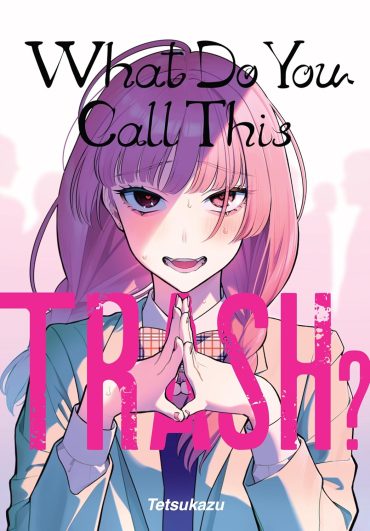
What Do You Call This Trash? Review
 Ian Wolf •
WARNING: This manga covers subjects including attempted suicide.
When you’re reading stories about stalking, you’re going to expect certain tropes, and while some of these come up, What Do You Call This Trash? does take us in some unexpected directions.
The stalker in question is a girl named Akira Ebiguchi, who was dating a boy called Kai Konatsu for a while before he left her because she was way too possessive. What Kai does not know is that his younger brother Yuuto is in love with Akira. As a result of this, Yuuto and Akira have entered into a deal where Akira will spend time with Yuuto, if she comes around to his bedroom because it is right next door to Kai’s bedroom and that way she can hear the guy she still pines for.
We, the readers, are left in no doubt as to how deranged Akira is in her stalking. Very early on she asks Yuuto if she can put a listening device in Kai’s room, to which he point-blank refuses. Much of the early sections of this manga (which consists of two volumes published in one complete collection) are comedic. When at school Kai bumps into both Yuuto and Akira, her lack of self-control is obvious, to the point she says she might wet herself. Meanwhile, Yuuto is oblivious to the fact that his female class rep has feelings for him.
Things however take a more dramatic turn when Kai announces he has a new girlfriend, Shion Nagano. Unlike his previous relationships, Kai thinks Shion might be the one for him, and she also hits it off with Yuuto due to their fondness for a particular tokusatsu series. Akira very quickly discovers what’s going on and it’s not very long before the whole web of lies and deception comes to a head.
As stated, this manga deals with some obvious stalking tropes. Not only is there a scene where Akira stands outside the Konatsu brothers’ house one rainy night until 4am, but she also has a secret room filled with photos of Yuuto, which personally gives me big Alan Partridge vibes.
However, it does also differ in other ways. While many stalking stories might end up with the stalker going completely mad and trying to kill the one they love or their rival, when the whole edifice of the relationships collapses, Akira decides to commit suicide by jumping off a bridge, only for Yuuto to stop her. While this is an interesting way to develop the story, part of me wonders if it is problematic that it is still the female character who comes off with a more violent conclusion, whether they be the one attacked by the stalker, or the stalker themselves considering the ultimate way out.
Nevertheless, Akira is not a one-dimensional character. We see the backstory of each of the main characters in the manga. Regarding Akira, we learn that she was named after her father who died before she born, and her mother tried to mould her into the shape of her late husband, this peculiar behaviour being a trigger for Akira’s own tendencies; her first meeting with Kai came about when he rescued her after she was pushed down some stairs.
As for production, the translation by Amber Tamosaitis is great, the lettering from Rachel J. Pierce complements the characters well, and the editing from Rory Nevins and Thomas McAlister joins the entire thing together nicely. There are some brief translation notes and a few colour pages at the beginning of the book. The combining of these two volumes into a single edition suits this title well, and the entire tale makes for a manga that mixes many different emotions.
If you are after something a bit more unusual when it comes to romance manga, this is a quick, diverting read that mixes comedy, drama and teenage angst and is recommended.
Read a free preview on the Yen Press website here.
Our review copy was supplied by Yen Press.