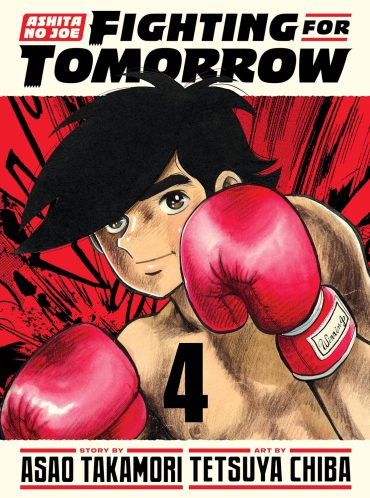
Ashita no Joe: Fighting for Tomorrow Omnibus 4 Review
 Ian Wolf •
When you participate in a physical and violent sport such as boxing, sometimes things can go tragically wrong. This is clearly evident in the fourth collection of this classic manga.
It picks up mid-fight, with ex-drifter Joe Yabuki currently facing off against his former juvie rival Rikiishi. Joe does manage to land a blow to Rikiishi’s head, causing him to collapse into the back of the bottom rope, but it is ultimately Rikiishi who wins the bout. However, it is Rikiishi who ends up the worst. While in the changing room, the press informs Joe and his team that just after the bout Rikiishi died, due to a combination of Joe’s punch, the impact on the ropes, and the extreme weight loss Rikiishi put himself through so he could fit into Joe’s weight division.
Afterwards, while Joe tries to put on a brave, non-caring face as to what happened, deep down he is deeply disturbed by what unfolded and that he killed someone in the ring. He goes on drifting, and while doing so encounters another former opponent, Wolf Kanagushi, whose jaw Joe broke in their fight. That injury ended his boxing career, and now he works for the yakuza. While he can handle most people, Joe witnesses Wolf losing to a proper yakuza brawler, and ends up intervening in the ensuing encounter.
Joe’s reaction to seeing what has happened to others around him ultimately leads him back into the ring. He gets back to winning ways, but Joe’s coach Danpei worries that the fight with Rikiishi still haunts him. To make things worse, the heads of the elite boxing gyms are keen to get rid of the upstart Joe, and start to arrange matches with much tougher opponents. Indeed, Joe does start to lose. Not only is he hitting less hard due to an unconscious fear of what he did to Rikiishi, but he even vomits blood in the ring. He ends up losing three fights on the trot, and finally feels like his talents have left him.
Loss is obviously the main theme of this collection. There are the clear number of fights Joe loses, although he does find some decent form in the middle of this collection, but it is the loss of his friend and rival Rikiishi which changes Joe fundamentally. After the initial shock, he still has to come to terms with how the outcome of the fight has changed him, even if he doesn’t know it at first. Danpei says that the ghost of Rikiishi still haunts him, and indeed Joe no longer hits as hard because of the fear that he might kill again. It is something that Joe needs to overcome, but just when it appears that he has, something still holds him back.
However, this is only one aspect of the loss. The other key element is the unfair advantage that those with the established boxing clubs have over Joe. They are the ones who get to pick who he will fight next, and Joe is willing to rush in and do those fights despite Danpei knowing that Joe has no real chance. It is at this point we need to remind ourselves of the impact Ashita no Joe had in Japan at the time it was first released. Joe was seen as the working-class hero battling against those who had power. It is understandable why left-wing political movements back then identified with the character. You can argue that the elite clubs are the owners of the elite businesses who are more than happy to go out of their means to crush any potential opposition to maintain their comfortable positions. If someone like Joe succeeds, it upsets their system.
To use a more modern analogy, the big clubs are like modern tech giants – your Amazons, Googles, Apples etc. – and Joe is like a successful start-up firm who provides a much better service at a better price. In the eyes of the giants, all opposition, no matter how small, needs to be gotten rid of, but we the public want to see the little guy succeed. Joe is the one putting up two fingers to the bigwigs, and we want to help him.
As for production, Kodansha’s staff continue to do great work. Annelise Ogaard’s translation continues to flow seamlessly, with editor Daniel Joseph, letterer Evan Hayden and cover designer Matt Akuginow still carrying on their high standard of work. Indeed, this combined with the engrossing tale, and the tragedy that Joe goes through, this in my view is the best collection of Ashita no Joe so far. I cannot see anything wrong with it.
With the fifth collection coming out soon, and Joe currently being at his lowest, let’s hope that the boxer gets the turn of fortune he needs.
Our review copy from Vertical was supplied by Turnaround Publisher Services.