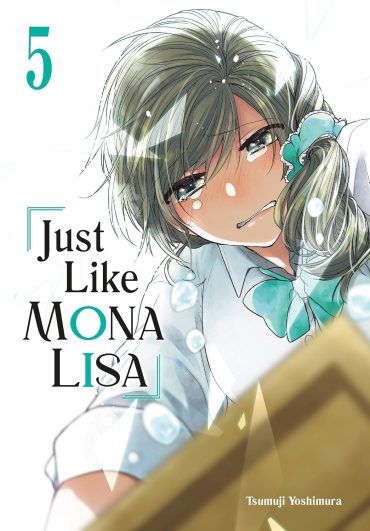
Just Like Mona Lisa Volumes 5 and 6 Review
 Demelza •
In the previous volume of Just Like Mona Lisa, Shiori and Ritsu were faced with working through their feelings about Hinase and how they’d feel if Hinase ultimately ended up the same sex as them. Now there’s an air of uncertainty surrounding the trio, but no one is prepared to give up on their romance quite yet. With two more volumes in hand, let’s find out how the story develops from here!
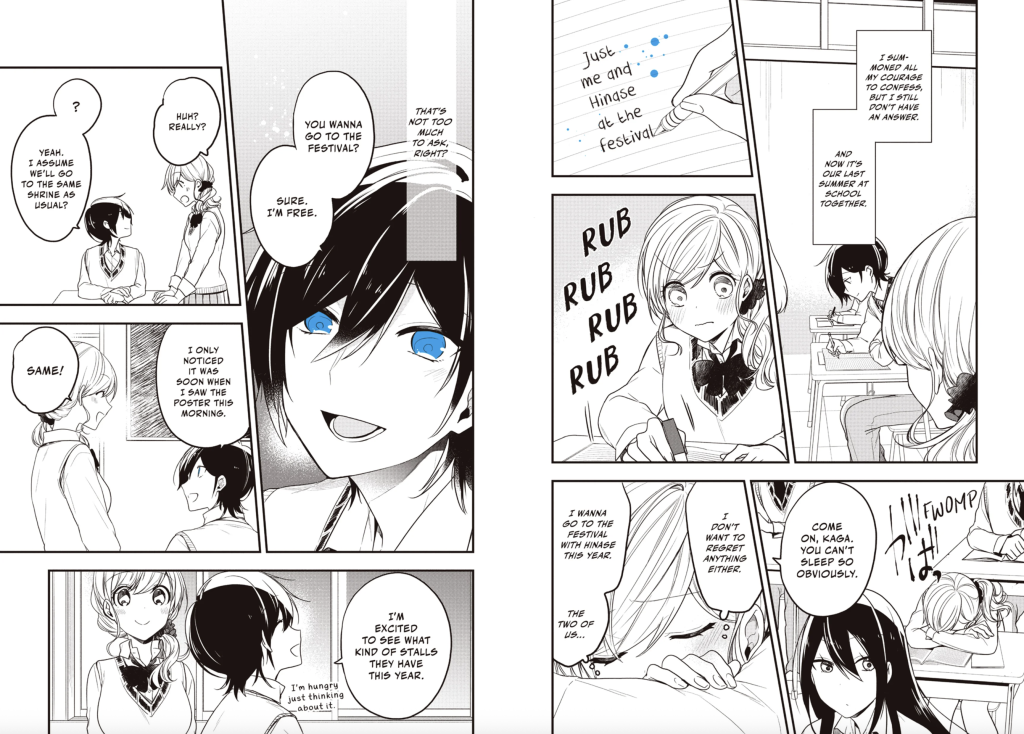
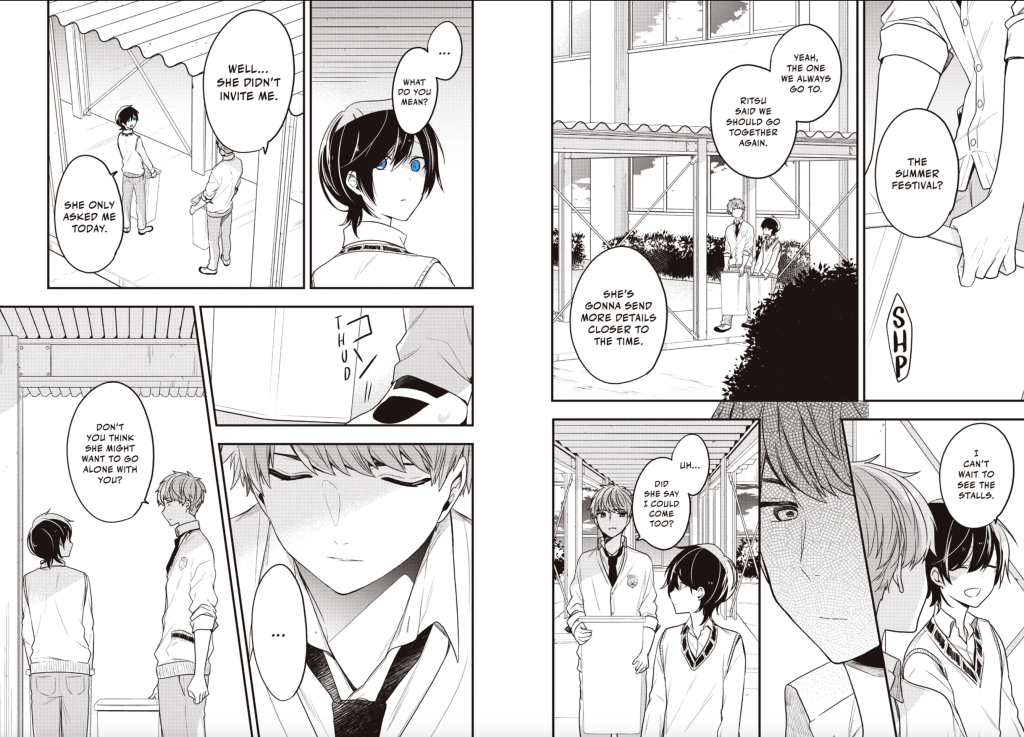
It’s time for the local summer festival, which Hinase normally attends with both her childhood friends. However, this year Hinase is invited by Ritsu, and when they then ask Shiori about it, he refuses the invitation. Shiori reasons that Ritsu was hoping to make it a date, and in her position he would also want Hinase all to himself rather than going as a trio.
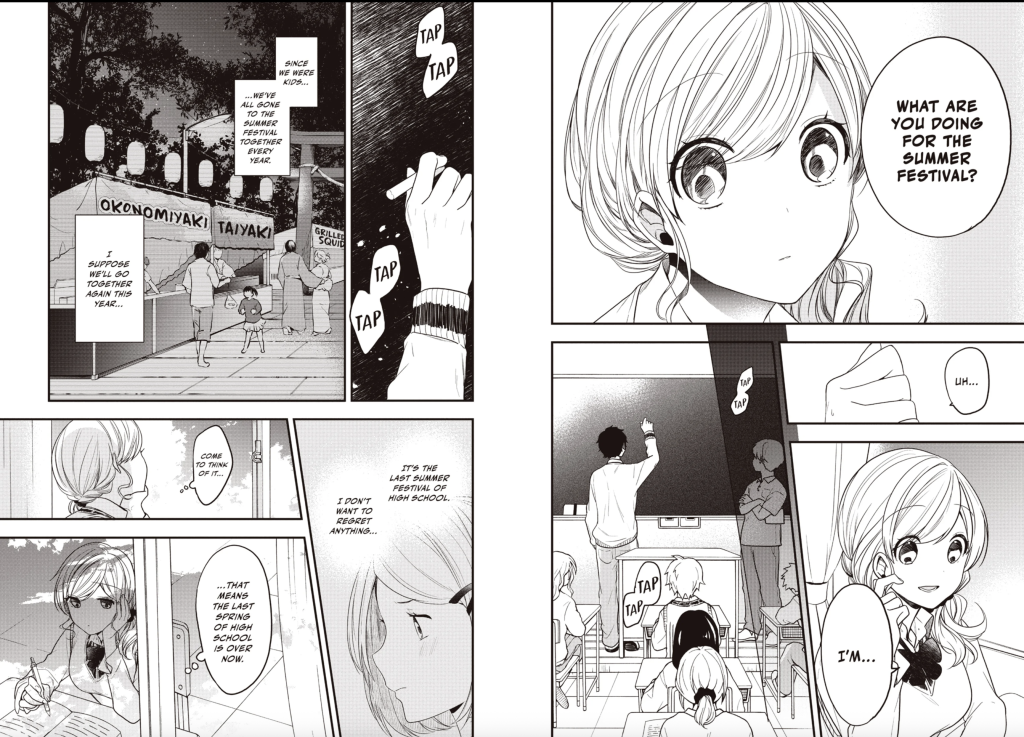
Hinase isn’t the only one struggling with the looming festival; Shiori’s friend Shirogane is also having trouble since his best friend Kurokawa has ditched him to go on a date instead. And this leads us into a compelling side story about Shirogane, who has grown up surrounded by sisters but never wanted to be a girl. Instead, he has to contend with the fact he’s happily male but also deeply in love with Kurokawa and jealous of all the girls who freely ask him out without having to worry about not ‘being normal’.
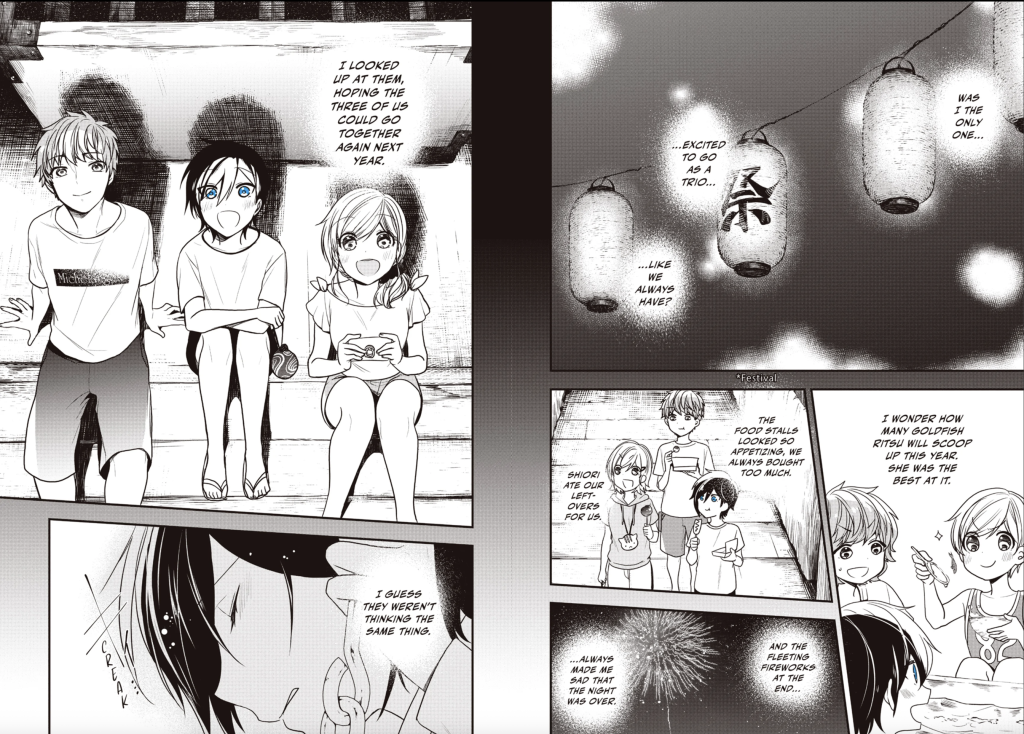
On the night of the festival, both Shirogane and Hinase find themselves distracted by how they used to spend their time with their loved ones. Ritsu, meanwhile, is totally oblivious to Hinase’s feelings and instead enjoys their time together while working up the courage to confess her feelings all over again, desperately hoping that she might get a different answer this time.
And this time, Hinase’s answer is slightly different to before. They tell Ritsu they do like her, but that Shiori is also precious to them. Ritsu initially takes this as being turned down, but later that evening Hinase summons them both to a nearby park and clarifies that they like both of them. However, because Hinase likes both of them, they feel like they’re two-timing them at the same time. Hinase proceeds to turn them both down until they’ve been able to work through figuring out their gender, and then they’ll ask one of them out afterwards.
This is where I grew incredibly frustrated with this series. Over the course of the last three volumes, we’ve seen a lot of focus on romance and being in love with someone who is the same sex as you. We’ve seen discussions about love and sexuality in many different forms. In fact, even just in Volume 5 we have Shirogane who wants to be with Kurokawa forever no matter what. So then why was Hinase’s first move to turn them both down instead of considering perhaps dating them both?
On the one hand, polyamorous relationships certainly aren’t a common concept in Japan, and so I understand how that wouldn’t readily be on the mind of the author. But on the other hand, this is a series that has so far been so committed to showing us how both relationships and sexuality don’t have to fit within the constraints of tradition or what many people consider ‘normal’, that for Hinase to not even consider the option of dating both of them feels really odd to me and like it undermines everything else.
And more than that, it feels like Hinase is being forced down a path of choosing one gender or another, which is something I never thought the series would do. Sure, with the premise being that anyone who doesn’t end up choosing a gender dies, I figured eventually Hinase would transition one way or another. But I also thought there was a high probability that Hinase did remain genderless and lived their life happily like that. That kind of representation would have been better in my opinion. I’m just struggling to see this going in a direction that I will be happy with in the end, and I think a lot of readers who identify as nonbinary or otherwise may find themselves uncomfortable with the message the narrative is beginning to push. Which is a shame when I’ve been able to champion this for so long for all the things it does get right.
Still, we’re not at the end yet, and there’s still time for mangaka Tsumuji Yoshimura to turn it around. But even if they are committed to this turn of events now, that doesn’t undo all the good representation that the story has had up until now either.
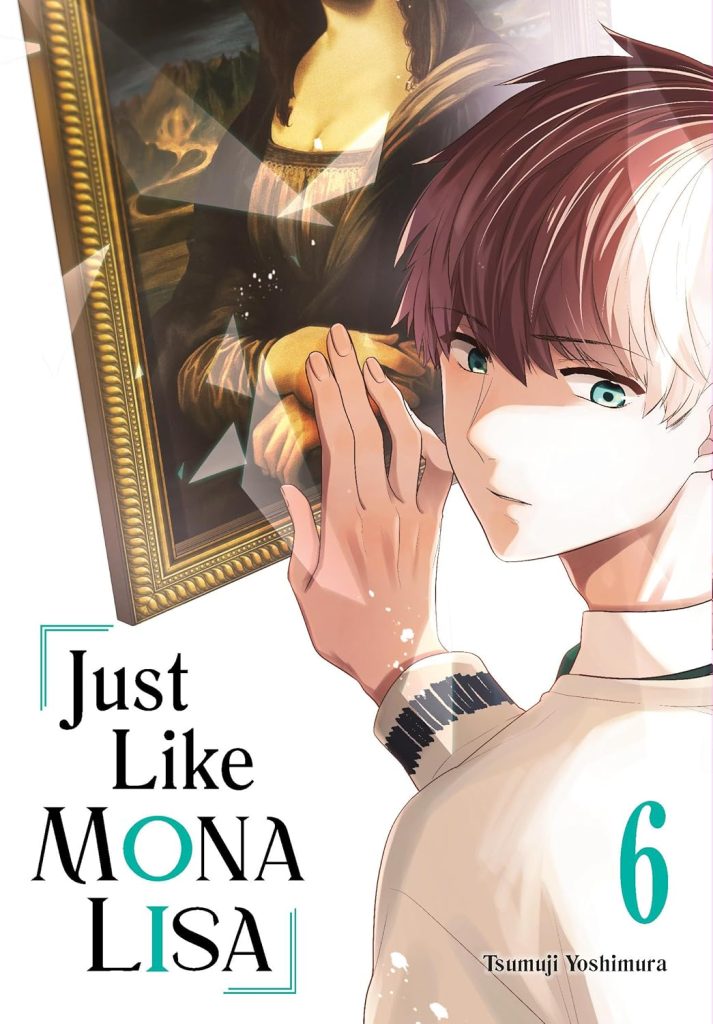
These two volumes of Just Like Mona Lisa come to the West thanks to Square Enix Manga and continue to be translated by Leo McDonagh with lettering by Asher Caswell (Kyla Aiko for #6). Both books read well and come with colour pages at the beginning.
Volumes 7 and 8 have already been released in English, with the next being #9, which is scheduled for May. At the time of writing, #10 is also pencilled in for May, but I would be somewhat surprised if we got two releases together.
Overall, these volumes of Just Like Mona Lisa are some of the best and worst of the series so far. For something that’s so enlightening and embraces many different ways there are for people to live their lives, it’s become surprisingly narrow-minded when it comes to Hinase’s potential relationship. I’m hoping as we continue toward the climax my feelings will change, but either way this feels like it will be a sticking point for many readers.
Free previews can be read on the publisher’s website.
©Tsumuji Yoshimura / SQUARE ENIX CO., LTD.
Our review copies from Square Enix Manga were supplied by Turnaround Comics (Turnaround Publisher Services).