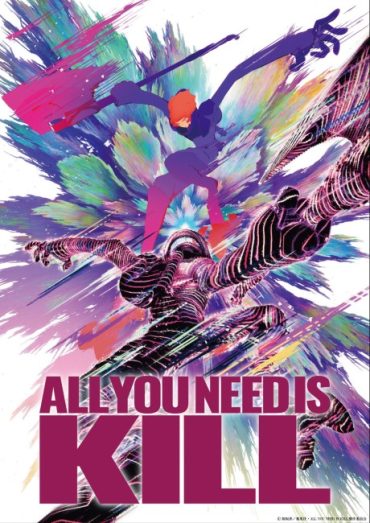
INTERVIEW: Kenichiro Akimoto on the “colourful, vibrant hell” of ALL YOU NEED IS KILL

In the future, a soldier at war with invading aliens finds themselves caught in a time-loop: whenever they die, they wake up at the start of that day, to fight and die again – with the hope of getting even one step closer to actually seeing tomorrow. This is a story you’re probably already familiar with, if not from Hiroshi Sakurazaka’s original light novel ALL YOU NEED IS KILL, but from the manga adaptation from Ryosuke Takeuchi and Death Note artist Takeshi Obata, or even the Hollywood blockbuster Edge of Tomorrow, starring Tom Cruise and Emily Blunt. Each iteration of this acclaimed Sci-Fi story adds its own style and spin on the novel concept, and there is perhaps no better signifier of how much freedom there is to explore this idea than in a brand new anime film Studio 4°C, which releases in cinemas across the UK and Ireland from Friday 27th February.
While visiting the United Kingdom to attend the premiere at Scotland Loves Anime, we had the opportunity to sit down with director Kenichiro Akimoto about his new adaptation of ALL YOU NEED IS KILL. Questions were also provided by fellow Anime UK News writer NOEMI10.
Q: All You Need is Kill is your directorial debut, but you have previously worked on films such as Berserk: The Golden Age Arc and Children of the Sea. I was wondering if you could talk about your career, and how you came to take on this project?
A: Yes, as you mentioned, I have worked on various works up until this point, and Studio 4C’s CEO [Eiko] Tanaka and I were talking about future works and we agreed it was the right time for me to take on a directorial role. I was also interested in exploring SciFi as well, then Warner Bros. approached us with this project. So, it was fortuitous timing as everything came together perfectly, like it was meant to be.
Sakurazaki Hiroshi’s original novel has been adapted before, into a manga series and a Hollywood movie. Including your film, they are all very different despite having the same core premise. What do you think gives this story such universal appeal, and room for creative expression?
I think absolutely, I agree. This work seems to have the capabilities of allowing different creative avenues. Part of the reason, I believe, is the generosity of the original writer – he allows room for different styles of adaptations. When we look at it as a wider genre, as it were, time-loop is a genre that already exists, so there are lots of possible different avenues that this story could take within that. This story is told from really different perspectives, though, if you look carefully in the original book. People tend to think of it as just Keiji’s perspective, but that’s not exactly correct. There is Keiji’s perspective, as well as Rita’s, and even the invading Mimics’ as well. So, these are in the original, and these essences really spark inspiration for different adaptations and styles.
You mentioned that the original book also featured Rita’s perspective as well. A lot of the previous adaptations we’ve had focused more on Keiji (or in the case of Edge of Tomorrow, the character they transformed him into), but your film focuses more on Rita’s perspective. What inspired that choice?
I think part of the reason was because all the other works were depicted from Keiji’s perspective – as you mentioned, the original book, as well as Hollywood’s adaptation were told by Keiji. When we explored what is possible from the animation standpoint, to really explore our own speciality, it became more important to see the world through Rita’s perspective.
Darol feels more like a dormant force of nature, like a volcano or a parasite, as opposed to the ongoing war with Mimics seen in other versions of the story. What inspired that take on this aspect of the mythos?
In the original story, Mimics aren’t depicted strictly as a clear villain – these creatures are factory machineries that are being sent to the Earth for terraforming purposes. So, they themselves don’t have any ill intent as it were, but they just happen to cause threat to humans just by them existing. Darol is the same as well; it was sent to Earth and just so happens to sprout on the Earth, and widen its scope without its intent. That is something beyond their control, but a lot of these scenarios do exist in the real world that we live in – many of us don’t have any ill intent, but do cause consequences onto other peoples’ lives – climate change could be one example. None of us actively want to destroy our Earth, but end up doing so in our day-to-day activities. The same can be said of all the wars happening across the world as well – one country does not have a clear motivation to destroy the other, but to protect its own country, which ends up destroying the other. These kind of misshapen relationship dynamics do seem to occur across the world, so it was something I was conscious of depicting.

The combat jackets that Rita and Keiji wear have a sleek design almost like space suits, that allow for nimble action sequences. What was the design philosophy behind the suits, and how they were animated?
Yes, and I understand the reason you’re asking that question – other adaptations had a more mechanical feel to their suits; particularly in the live-action version. It was well done, and apparently they made the suits just for their live-action purposes. When we thought about what would look best in animation’s setting and designs, I believe one of the important elements visually in animation is the silhouette, so we really thought about what would look the most sleek and beautiful with the character. The original idea came from Mr. Okubo, who is really the original designer, and [character designer] Izumi Murakami. She really explored and made it perfect for our film.
The film as a whole has a distinctive, vibrant art style. I was wondering if there were any particular influences for you, and how you wanted the film to look?
This film depicts the repeated cycles of life and death, so to really highlight the life element as opposed to the incoming inevitable death, we wanted to really make life look more vibrant and appealing – the ones Rita needed to live again and again. So, we were conscious of needing to make it colourful and vibrant.
Another stylistic element that I thought about was to create a colourful, vibrant hell in terms of the visual image that I had in my head, to really depict the cruelty set against beauty. As far as visual inspirations, there are a few things that I thought about. One is the Danakil Desert in Ethiopia, and that type of scenery.
ALL YOU NEED IS KILL releases in cinemas in Japanese with English subtitles and Dubbed in English from Friday 27th February. You can find your nearest screening at aynikfilm.co.uk
Disclosure: As well as a seasoned Anime UK News writer, Josh A. Stevens is also an employee of Fetch Publicity, who are managing the publicity for the film. All thoughts and opinions expressed in this interview are his own, and the contents of this feature adhere to Anime UK News’ journalistic independence.