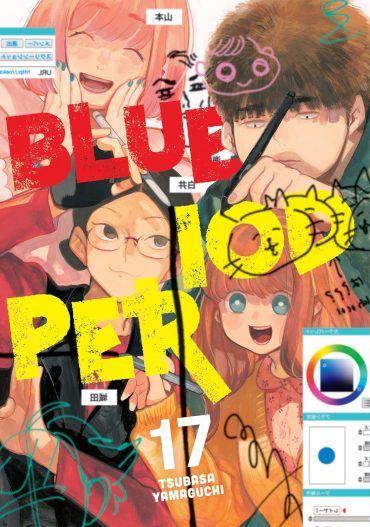
Blue Period Volume 17 Review
 Sarah •
Each and every word that senpai gives me… feels like a treasure. Yatora
Yatora’s host club billboard artwork, created for the ‘two person show’ project and using Andy Warhol as his ‘partner’, has been a success. But to finish off the second year, the students now have to create an ‘advancement exhibition’ – and that means they will need financial resources to deliver in January. Yatora is also planning to go on a trip to Europe with Hashida to see the Venice Biennale – so he’s soon back at the host club, keen to earn what he can to pay for these expensive upcoming outlays! In fact, he’s eager to earn money wherever he can, which is why he also works alongside Yuka at a bar and then finds himself off to Comiket to help their old school art club classmates Umino (who has thousands of followers for her manga), Shirai and Shirota sell doujinshi. This is a real eye-opener for Yatora who can’t get over the vast numbers of attendees – or how invested the fans are in the work of their favourite mangaka! This leads to the setting-up of a reunion for the art club; Saeki sensei is invited as is Mori-senpai, whose work/paintings first inspired Yatora to take up art. Yatora hasn’t seen his idol Mori-senpai in a long while and finds himself strangely agitated at the prospect. (Does he still have a crush on her? Well, probably…)
And so the reunited high school art club members decide – it’s Mori-senpai’s idea – to put on a joint exhibition in January (Yuka included). They find a suitable venue to rent and start to make plans, including deciding whether to sell their works (something Yatora has never done so far but there’s no time like the present!). They play around with ideas for a theme and a title and Mori-senpai’s suggestion ‘To You’ appeals, so that seems to be the one they’ll be using. In the meantime, Yatora becomes fascinated by the concept of Olfactory Art and is beginning to investigate its possibilities after being sprayed with a rather distinctive perfume by instructor Maria Hanakage who says she’s going to create an installation with it. But spending time with Mori-senpai has unsettled and delighted him in equal measure; inevitably his old school friends are wondering how much he likes Mori-senpai. When she invites him to go to an exhibition of conceptual art by the artist Félix González-Torres with her, he’s confused and excited, wondering why out of the group she’s chosen him and repeatedly telling himself, Don’t get your hopes up!!. Once at the exhibition, he begins to understand why she invited him because there’s so much to discover and to think about…
In some ways Volume 17 of Blue Period is a transitional volume as it charts the time between the end of Yatora’s second year and the start of the third year. It’s also nostalgic for him (and for us) as he meets up with his high school art club peers and learns what they’ve been doing. Comiket is a real eye-opener for him, stimulating some deep thoughts about the power of manga art to communicate with so many viewers/readers. (A little treat for keen-eyed readers too is the manga art featured at Comiket by mangaka friends of Tsubasa Yamaguchi, all credited at the end of the book, including Tsuta Suzuki, Posuka Demizu and Kamome Shirahama!) But long-term fans of Blue Period will be – like me – longing to find out what happens when Yatora and Mori-senpai meet again. No spoilers here – but this is one volume you won’t want to miss!
Every time I open a new volume of this engaging and quietly thought-provoking series, I’m impressed at the way Tsubasa Yamaguchi keeps us involved in the lives of her characters as they try to find their way as artists and creators. From the colourful cover art to the 4-koma panels at the end, there’s a great deal to think about. Yatora’s journey to find himself as an artist is always sympathetically portrayed, even when things don’t go well for him. And if that sounds a little precious, the manga is far from that; his encounters with old school contemporaries and more recent acquaintances deliver plenty of realistic, funny and touching moments.
There’s a new translator for Kodansha, with Lindsey Clifford taking over from Ajani Oloye but Lys Blakeslee is still doing the lettering and both deliver a good read, As well as the mangaka’s special thanks page (mentioned above) there are two very helpful pages of translation notes. Volume 18 came out in autumn 2025 in Japan, so no date yet for the US edition but hopefully we won’t have to wait too long.
Our review copy from Kodansha was supplied by Diamond Book Distributors UK.