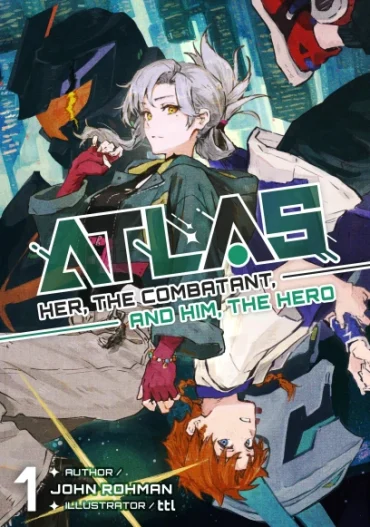
ATLAS: Her, the Combatant, and Him, the Hero Volume 1 Review
 Noemi10 •
‘Welcome to Secret Society ATLAS, Combatants. Try not to die.’
ATLAS: Her, the Combatant, and Him, the Hero is my first novel from J-Novel Club. I had some expectations, so keep on reading to figure out if they have been met!
Calli, short for Calypso, comes from Strata, a region best represented as underground levels that help sustain all that is NOAH. In fact, in this futuristic world, eons have passed and wars have shaped the world to be what it is now—a giant conglomerate set up on levels that is supported by four companies all vying to one-up the others for power. They do so with the use of heroes.
Although Calli now lives on the ‘ground’ level that is NOAH, she is mistreated, harassed and bullied just because she is a Stratan, and there is no way for her to hide it due to her white hair caused by her growing up below ground. It’s hard to get a job because of where she comes from, so she keeps doing odd jobs at an agency run by Argus, the only person who seems to treat her fairly. However, the money she makes is not enough to send to her adoptive family back in Strata, so when Argus proposes a new role, she doesn’t expect to become a part of ATLAS— an organisation whose goal is revolution and whose members are villains (aka combatants) bent on changing the status quo and taking down the top powers of NOAH.
Genesis is a young scientist whose will to save the lives of his co-workers attracts the attention of Oz, one of the owners of the four big corporations who blackmails Genesis into becoming a hero when he finds out that Genesis has the power to see the future. Genesis doesn’t have any other choice but to accept, but his first few missions as a hero make him cross paths with combatants, members of ATLAS.
ATLAS: Her, the Combatant, and Him, the Hero is written by John Rohman and illustrated by ttl. It won the Grand Prize in the first J-Novel Club Original LN Contest in 2024, and now it’s published by J-Novel. When I started to read it, I was expecting something similar to a Japanese light novel, with a quick and easy to read story and a few illustrations to depict the characters. However, I’d remove the word ‘light’ from this series and call it a full-blown novel. Not only due to the high word count but also the complexity of the world building, which even after I’d read the whole volume was still not super clear to me.
This series entwines science fiction with the use of technology and supernatural powers, a political revolution, heroes and villains, and even the start of a romance. There is a lot to unpack, and while the first volume gives readers the basis to start understanding the story, there is still much more to come, especially thanks to the hints given in the last chapters of the volume. I have theories about them, but it’s still too early to share them.
Although Calli has been discriminated against because of her origins and her hair, she has always picked herself up and never gives up on the challenges. It doesn’t help that she has a quick temper, and fists might be flying before she can even process what she’s doing. She is one of the few who have meta human (aka supernatural) abilities. Hers is only D-rank—her body can adapt to her surroundings— and it doesn’t seem to appeal to prospective employers, so although she has doubts, working for Atlas is her best option for earning money. The exosuit she needs to wear to accomplish her terroristic missions enhances her skills and the heroes she has to face are what brings her the hazard and bonus pay.
Genesis is an average man who’s ok with working for one of the big corporations. However, he has never disclosed his meta human ability to foresee the future and now he’s been roped into being a hero with a secret identity, as his newfound friend and neighbour—Calli—finds out on their second encounter. Things are not looking too bright for Genesis, especially when he doesn’t know that Calli is the combatant whom he faced off against.
The story is narrated from both Calli’s and Genesis’ point of views, although the third person singular is used. The narration is not linear; the novel starts in the future with a prologue but then goes back to the time when everything began from each character’s point of view. There are no flashbacks, but the chapters start with the day the events are happening to help the readers keep track of the timeline, which is only a little over a week.
The volume has a few illustrations depicting random moments in the story. Personally, I would have preferred to get better visuals of the characters with their exosuits on to get a better understanding of their attire. Overall though, I enjoyed the story and I’m excited to read how Calli and Genesis’ relationship will develop and find out more about the workings of NOAH, although no release date has yet been announced for the second volume.
Our review copy was supplied by Yen Press.