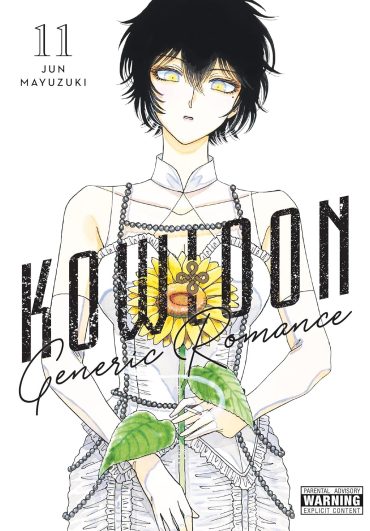
Kowloon Generic Romance Volume 11 Review
 Sarah •
Warning: Spoilers!
“As long as you exist, Kudou will keep lovin’ Kowloon,” Yulong to Reiko, “and keep replicatin’ it.”
Gwen Tao, back in Generic Kowloon, is remembering what happened three years ago when Kujirai B died and the effect her death had on her fiancé Hajime Kudou. But where is Kudou now? No one knows. As Gwen’s wondering, he receives a strange phone call from a man claiming to have known Miyuki Hebinuma for a long time and asking him to re-establish his relationship with him. But Gwen doesn’t know that he’s talking to Yulong, Miyuki’s childhood friend and the brains behind Gene Terra, and hangs up.
Reiko Kujirai (A) also finds herself communicating with Yulong via computer where he delivers explanations of Gene Terra, Generic Kowloon and even her existence, before leaving her with another blunt message, “Do you wanna save Hajime Kudou? The solution’s simple. All you gotta do is take those pills and die.” The pills are the banned red pills developed by Hebinuma pharmacy as a cold remedy that was illegally circulated as a recreational drug, sometimes with lethal effects – and which caused Kujirai B’s death. And then Reiko finds herself in Kudou’s room where he still lies asleep… dreaming…
‘Is everyone in Generic Kowloon still living Kujirai B’s endless summer?’ I asked in my review of Volume 10. This is the penultimate volume of the compelling mystery series that has kept its many fans guessing (even though we’ve already been offered an ending in the anime TV version and the film, which hasn’t as yet been released in the West). Even at this late stage in the story, while some outstanding mysteries have been resolved, others are still to be answered. It’s difficult to discuss these plot threads without giving away what’s revealed in these chapters, so if you’ve yet to read this volume you might well want to look away now (or skip to the final paragraph).
At this stage, it seems to me that the main issues to be unravelled are all to do with Reiko Kujirai A’s existence which is shown to be inextricably tangled with/linked to Generic Kowloon. Those outside the city can see nothing but an abandoned dusty ruin, mostly demolished and desolate. But Kujirai A now understands that it’s always summer in the Kowloon she inhabits because she’s living in an alternative reality created from Kudou’s memories of his last summer there where time stopped the moment he discovered ‘his’ Reiko dead on her balcony. But it’s a powerful alternative reality as Miyuki Hebinuma, Gwen Tao and others still seem to be able to come and go from Hong Kong – although possibly at some cost. Why is this Reiko’s personality different from Kudou’s Reiko? If she’s a figment of his imagination and memory, why does she also exist in her own right and make choices that are different from those made by Kujirai B? We know that those from ‘outside’ can’t see or hear her (the pizza delivery man in Volume 7) – and that if she steps outside the walled city, she ceases to exist. But this volume shows us how the goldfish Kudou buys for her evolves from being ‘just a symbol’ into a real goldfish when she gives it a name: ‘Success’. Is this what has also happened to Kujirai A? Has her existence been somehow validated by interacting with the ‘real’ people who have wandered into Kudou’s dream Kowloon where it’s always summer?
Nevertheless, death and decay dominate a large part of this volume: Reiko undergoes a terrifying dream/vision in which she finds Kujirai B’s lifeless body and witnesses its decay. And in Kudou’s memories, we retrace his painful return three years ago with Kujirai B’s ashes to scatter them on the ruins of the bulldozed Kowloon before suddenly finding himself back in the bustling streets before the demolition.
Now that we (and Reiko) have an explanation (of sorts) from Yulong about G-Kowloon and her existence there, it makes sense – but it also raises more questions. To what extent can we accept Yulong’s explanation of this powerful and shared mass hallucination emanating from one person’s mind? (He himself can’t see or experience G-Kowloon – maybe because he never met or interacted with Kudou?)
However, Gene Terra, the twinkling futuristic object hovering above Kowloon that has been promoted as the cloud home/data bank for everyone’s memories and personalities which can be downloaded into ‘new’ physical bodies or ‘Zirconians’ thus ensuring a kind of eternal life, is now revealed to be a sham. Yulong, the IT/AI genius we’ve seen doing his best to kill Kujirai A, tells her that it’s fake just as Miyuki discovers that the Hebinuma Corporation has withdrawn its funding from the project.
And just to add a word of praise for Jun Mayuzuki’s art – and the use of panels (or lack of them, sometimes) to tell the story in such an impactful way; there are some truly stunning pages here that will resonate long after you’ve put the book down.
Praise (as always) for translator Amanda Haley and letterer Abigail Blackman for their consistently sterling work and also for the translation notes which add an extra dimension, especially to one scene featuring Miyuki, explaining an important panel which would be impossible to relay in English as we don’t have differently gendered versions of the personal pronoun ‘I’. Two nice extras, one about the mangaka’s cat and the other about the brands of cigarettes the characters smoke. And there’s a really charming colour picture at the front with chibi versions of all the main cast hanging out together in a typical Kowloon tenement block.
So, no clear answers or explanations still in Reiko’s quest for her ‘absolute self’ but many hints as well as Yulong’s careless instruction to her to take the pills and die to save Hajime Kudou. Is there another possible outcome to this shocking suggestion?
The manga has already come to an end in Japan with Volume 12, although we don’t yet have a date from Yen Press; here’s hoping we don’t have to wait till 2027 for it to be published in English.
Our review copy was supplied by Yen Press.