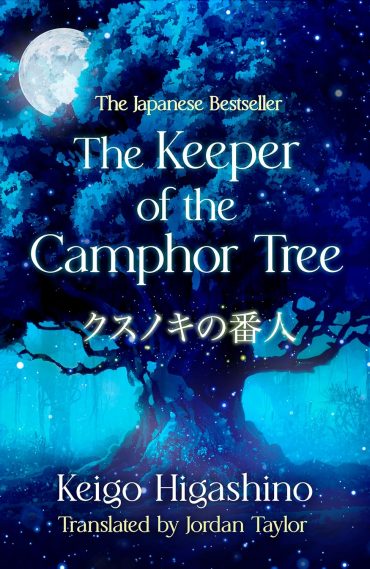
The Keeper of the Camphor Tree Review
 Demelza •
I like mystery and detective dramas, so I’m sure it’s of no surprise to anyone that I am a fan of Keigo Higashino’s work. And sometimes his work leans into stories that have a supernatural twist, like The Miracles of the Namiya General Store, as well as the work I’m here to talk about today – The Keeper of the Camphor Tree. Does this latest English release prove a must-read? Let’s take a closer look!
The story follows Reito Naoi, a young man who has been dealt a bad hand in life. Unjustly fired from his current job, Reito tries to take revenge against his boss by stealing an expensive piece of machinery said boss had just conned someone out of selling for far below market value. But Reito gets caught and finds himself facing years in prison. That is, until a distant aunt called Chifune Yanagisawa sends a solicitor who promises to get him out of this predicament provided he follows everything she says from here on out. With no other options, Reito accepts the deal.
Growing up, Reito lived with his mother (who sadly passed while he was young) and grandmother. With no father in the picture due to Reito being the product of an affair, he’s from a family that always struggled to make ends meet. So, he’s shocked both to learn about the existence of his aunt and that the Yanagisawa are a rich and noble lineage. And Reito is now being tasked with becoming the ‘keeper of the camphor tree’, a sacred role that’s passed through the family.
The tree is on the grounds of a Tsukisato Shrine, and it’s known as being a holy spot where people come to pray and have their wishes granted. Of course, Reito doesn’t believe in any of that, but now in Chifune’s debt, he has absolutely no right to do anything but take care of the tree, shrine and associated duties. During the day this simply amounts to everyday upkeep and ensuring none of the visitors damage the tree, but at night it’s a totally different story.
On nights of the full and new moon, visitors book a visit to the camphor tree, where they commune with it. And there are strict rules about who can enter the tree to do this, as well as the fact that no one but the visitor must go near the tree or disturb those communing. Even Reito. As he receives guests, Reito begins to wonder what the significance of this act is and why everyone is so insistent on calling it ‘communing’ rather than ‘praying’ or ‘wishing’. Although he asks Chifune, she refuses to answer more than the bare minimum of his questions, wishing that he find answers for himself as he learns the role and interacts with those who visit.
And so it is that we readers are also stuck without answers, helpless but to learn alongside Reito and piece together the knowledge he gathers. A situation that could be frustrating but isn’t, due to Higashino’s skill for crafting engrossing mysteries. Primarily, we’re following Reito through his daily life and his interactions with his grandmother, gradually revealing the story of his family and the history of the camphor tree. But there are also two recurring guests who come to commune with the tree.
Having these additional characters makes all the difference because it transforms The Keeper of the Camphor Tree from a story that’s just about Reito figuring himself out into a tale of familiar ties, legacy and the things that are often left unsaid. There’s Toshiaki Saji, who frequently visits, and his daughter Yume, whom Reito finds following her father. She’s convinced he’s having an affair and wants to figure out why he’s been acting so suspiciously lately, and Reito finds himself getting more and more involved with her investigation despite his initial reluctancy. And then there’s Soki Oba, a young man whose father has just passed and who is supposed to be inheriting his will by communing with the tree but has so far struggled.
It’s a well-balanced narrative that does well at building itself up over the course of the journey, jumping around the subplots often enough to ensure you stay engaged and not so often as to lose focus on what’s happening. Everyone’s stories are interesting, and I found myself repeatedly reaching for the book just to read a bit further and unravel the mystery for myself. Reito is an engaging lead too. He’s in over his head to start with, especially when around Chifune, given the difference in their upbringings, but he’s an earnest man who takes his role seriously – even if he doesn’t realise it himself at first. By the time I reached the end, I felt satisfied to have watched his journey and gotten all my questions answered.
But perhaps what I enjoyed most of all was the setting itself. One that’s steeped in something that’s supernatural but believable, just like folklore. Reito’s scepticism is what you’d expect when being told of a tree that grants wishes, but the results of what he sees aren’t so unnatural that you would find yourself turning into a believer in his shoes too. It’s believable but not intrusive; you don’t have to buy into it as a reader to fully appreciate the story Higashino has penned.
The Keeper of the Camphor Tree comes to the UK thanks to Little, Brown Book Group under the Abacus Books imprint and has been translated by Jordan Taylor, who has done an excellent job! This has also been adapted into an anime film by A-1 Pictures, which was released in Japanese theatres in January.
This was originally released in Japan in 2020, and there has since been a sequel novel, which I hope will make its way over here in due course! There are plenty of Higashino’s other novels in print, but as for new releases, next up is The Dark Magician from Tuttle Publishing in October and Laplace’s Movement in November, which is published under the upcoming Yen Press imprint Avocado House.
Overall, if you’re looking for a mystery novel that’s not as dark or part of a larger series like some of Higashino’s, this is perfect. It finds that perfect balance of not telling you too much too fast, but also giving you just enough to get invested in figuring out the bigger picture. Perfect for newcomers and returners to the author’s work.