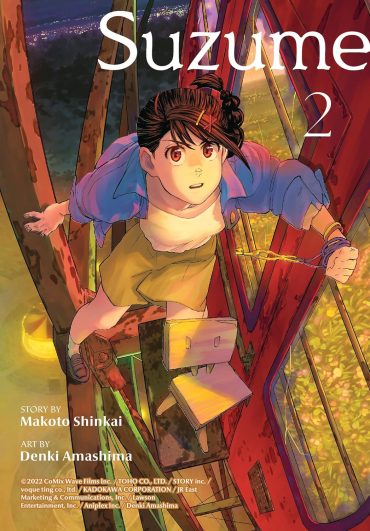
Suzume Volumes 2 and 3 Review
 Demelza •
The manga adaptation of Makoto Shinkai’s Suzume got off to something of a rough start with Volume 1, but will mangaka Denki Amashima find their feet in these final two volumes of the series? Let’s find out!
Volume 2 picks up where we left off, with Suzume and Souta (in chair form) chasing after the keystone, Daijin. As they race across Japan, following his path, they encounter more doors that need to be closed, as the supernatural Worms threaten to strike Japan with disastrous earthquakes if they are not sealed in time. But unless they can get Daijin to resume their role as a keystone, closing the doors will be nothing but a temporary measure.
Unfortunately, Daijin is enjoying their newfound freedom and has no particular interest in returning to keystone duty. And seeing as turning Souta into a chair hasn’t been enough to stop him, Daijin soon sets about trying to force Souta into taking on the role of keystone. And in the meantime, Suzume is coming to grips with what Souta’s role really means and the hardships he’s gone through due to it. They eventually find themselves in Tokyo, where Suzume encounters one of Souta’s closest friends and finds herself facing their biggest challenge yet.
It’s toward the end of Volume 2 that Souta is left with no choice but to become the keystone in place of Daijin, which Suzume reluctantly agrees to at the time but isn’t happy about. Immediately afterwards, Suzume visits Souta’s grandfather, hoping to find a way to bring him back. And in the midst of this, her aunt Tamaki finally catches up with her…
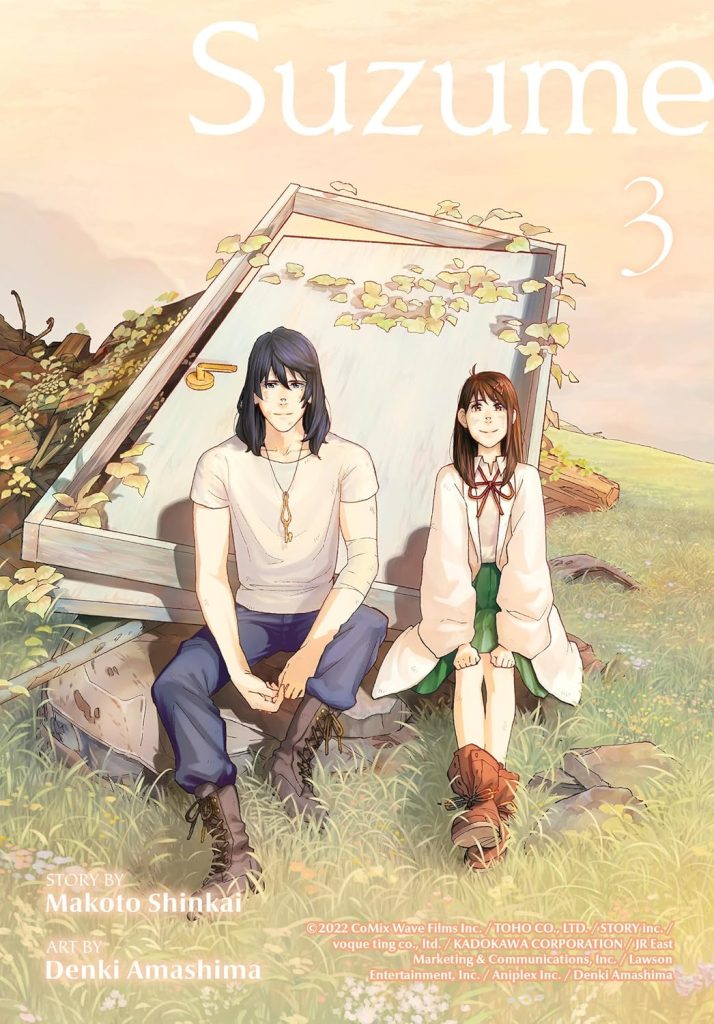
Suzume is a coming-of-age story combined with a fantasy adventure. Our heroine grows a lot over the course of her journey as she meets a variety of different people while chasing after Daijin. She, of course, feels responsible for everything that’s happening due to setting Daijin loose in the first place, but there’s also a sense that this adventure will finally give her the closure she needs for the death of her mother.
And these are themes that Shinkai’s original film explores really well. Not just with Suzume, but also Tamaki, who has complex (and realistic feelings) about having ended up becoming a parent to Suzume when they were both so young. And of course, these feelings are shown in the manga as well, but it feels like the delicate portrayal of the emotions is missing.
This is not helped by the pivotal scene of Souta becoming the keystone in Volume 2, which feels underwhelming compared to the original. In the film, this is a pivotal scene that acts as a major turning point for the story and for Suzume. There’s a real sense of urgency and heightened emotions, as well as it being a visually stunning sequence in general. Unfortunately, Amashima hasn’t been able to replicate it. And because of that, we’re not getting the same feelings going into the last act, which means the conclusion doesn’t feel as satisfying as it does in the original work.
Admittedly, I had this fear after reading Volume 1. Amashima isn’t doing a terrible job here by any means, but a serviceable adaptation without adding anything means there’s no compelling reason to pick this up over watching the original. I like reading the manga or novelisations of Shinkai’s work precisely because they usually try to build on the narrative by adding some extra characterisation to the cast, even if just in subtle ways. But this is a really ‘safe’ take on Suzume, that sticks to the source strictly and ends up all the worse for it. Amashima’s art is okay, but it’s not strong enough to offer a compelling reason to read the manga to experience it, either. Which is a shame!
Suzume Volume 2 and 3 come to the West thanks to Kodansha under the Vertical imprint and were both translated by JM Iitomi Crandall. The books read well, but there was a translation choice I found confusing where Souta’s friend says that Souta owes him “twenty grand”, and then there’s a translation note in the margins that states that’s approximately $150. The problem is that going for such a colloquial term and no explanation that they’re talking about yen, the translation note doesn’t make sense (especially as you wouldn’t ordinarily refer to that much yen in those terms). This unfortunately comes up in both volumes, so it is less than ideal even if not a big deal on the whole. It’s just unnecessarily confusing. Otherwise, not a great deal to note, as there are no extras included in any form.
Overall, these two volumes bring the Suzume manga to an end in a way that’s not particularly satisfying. It’s not that the manga has done anything particularly wrong, but by playing things so safe and not landing the pivotal scene in Volume 2, I just can’t find a good reason to recommend this over or in addition to the original film.
Our review copies from Kodansha (Vertical) were supplied by Turnaround Comics (Turnaround Publisher Services).