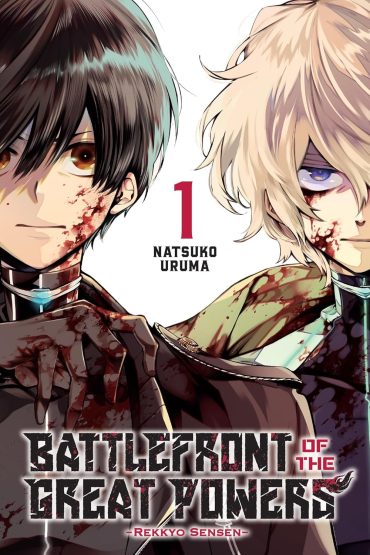
Battlefront of the Great Powers: Rekkyo Sensen Volume 1 Review
 Noemi10 •
Battlefront of the Great Powers takes its readers to a future Earth where resources are limited and only a few countries still exist. But with only 100 years left before the Earth stops providing humanity with a future, what can humans do to survive?
The remaining 16 leaders of the UN decide to have a battle among their chosen ‘heroes’ that will exterminate the population of whichever country loses. Is it fair? No, especially as some countries are still stronger than the others, but that’s what Gaia, the AI system, advises humanity to do.
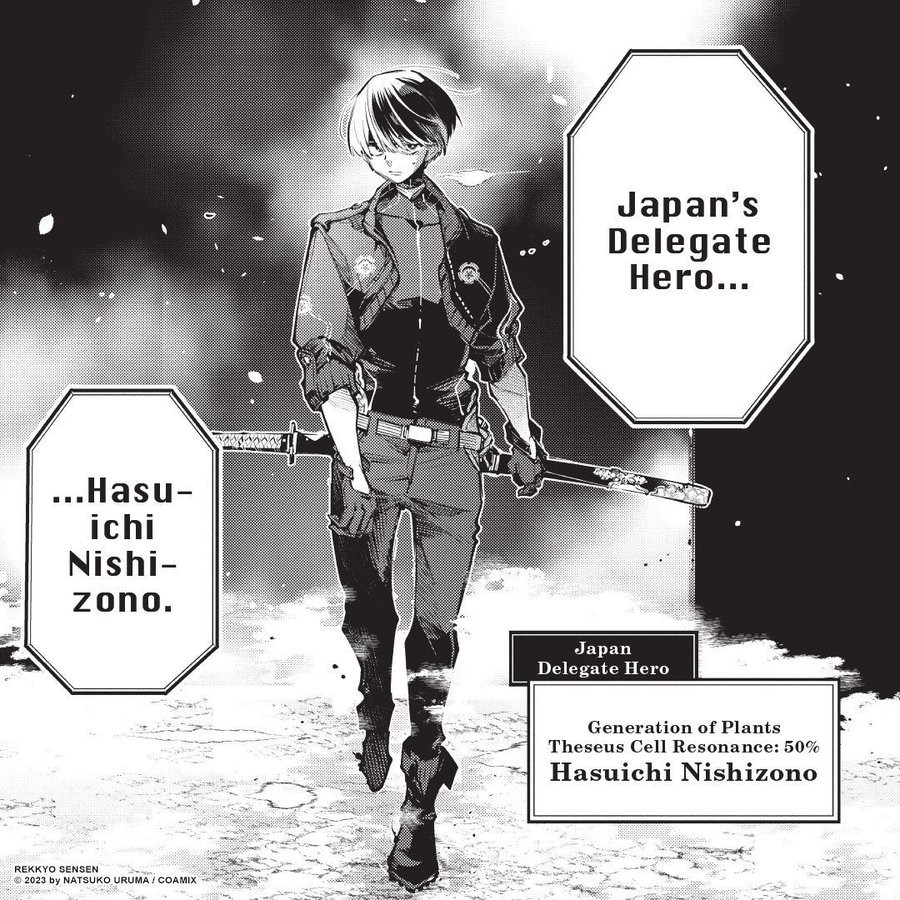
In a world where its inhabitants have to use oxygen masks since the air has become poisonous, a group of people exists—people who developed special powers because they have Theseus cells which allow them to breath air without a mask and to morph their bodies. They are similar to mutants, and it’s in the Nation Extinction Tournament that they will shine. Whichever country wins a battle can demand a prize from the losing country and save the lives of its citizen. Moreover, Gaia will give the winning nation of the tournament a chip containing all the passcodes to switch off the oxygen masks in one of the world’s remaining nations—it’s a battle for survival! The first nations to battle are the UK versus Japan, where Hasuichi Nishizono, the son of Japan’s prime minister, has been chosen as his country’s Delegate Hero. Who will win?
The manga starts by explaining what’s going on and what caused the issue so we get to have an understanding of the foundations of the story. The UN meeting held by the sixteen remaining nations is the forum which delivers most of the relevant information, followed by the commentary by Gaia and her AI minions, which were originally developed in 2030 to aid in the survival of humanity. Gaia’s predictions are never wrong and, 200 years later, humans still follow her word, so if she says a genocide in the form of a tournament is necessary, humanity listens. Not everybody agrees, but what can they do when they are in the minority and survival is the prize?
In this first volume, we don’t get a clear view of the characters. The assumption is that Hasuichi Nishizono will be the protagonist as we see snippets of his past and his will to fight and protect this world. He seems a naïve character who is willing to fight to protect his people, but who also wants to save the other nations. I’m still not sure if this is a quality that will make him grow stronger or if it will be an obstacle to his growth. It’s too early to decide if he’s worth cheering for as we don’t get to know him much or see what he’s capable of.
It’s interesting to find out about the Theseus cells. The tournament is arbitrated by AI, which gives commentary and explanations to the tournament viewers and readers alike. The cells seem to be a mutation that some humans get that allows them to develop special skills and change their cellular makeup. How much strength they have depends on their resonance and more information will probably be divulged in upcoming volumes. This volume is just an introduction to the world and the story setting, mixed with some action, and I’m pretty confident in assuming that following volumes will see even more action.
From start to finish, Volume 1 delivers a manifesto of what will happen to Earth and humanity based on current events—a world-wide pandemic, war and pollution are just a few of the examples presented in the manga. They offer a grim preview of a future that seems more like a warning to start a change right now. Another element that takes centre stage is AI. Artificial Intelligence has become what can save or destroy humanity, and world leaders trust it to predict the best course of action to take to make sure people can survive. If this is also a warning or encouragement to use AI is still to be seen!
Battlefront of the Great Powers by Natsuko Uruma is released in English by Yen Press with a translation by Luke Hutton. There is no release date yet for Volume 2.
Read a free preview on the Yen Press website here.
Our digital review copy was supplied by Yen Press and Edelweiss.