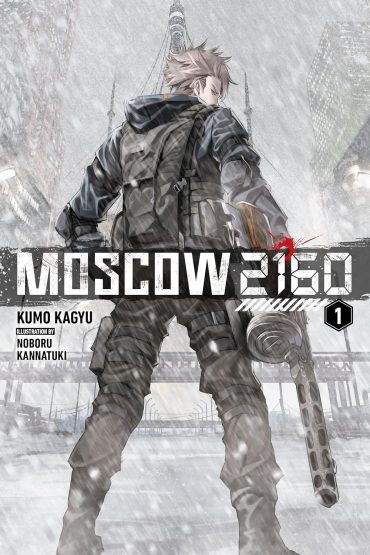
Moscow 2160 Volume 1 Review
 Ian Wolf •
When it comes to certain types of creative work, you sometimes get the impression that people are relieved when it breaks from what’s the most dominant form of its type. For example, when it comes to anime and manga, you might get the impression: “Oh, it’s not isekai. That’s different.” When it comes to alternative history, I suspect a similar reaction is: “Oh, it’s not about the Nazis winning the war. That’s different.”
From Kumo Kagyu, the creator of Goblin Slayer, the key change in Moscow 2160 in history occurred on 24th October 1970. While the USA was busy dealing with its Star Wars defence programme, it would be Vladimir Komarov of the USSR who becomes the first man to walk on the Moon. The Russians won the Space Race, the Soviet Union never collapsed, and the Cold War is still being played out in the 22nd century.
The novel’s year and location are obviously given away in the title. In a year in which Moscow is preparing to host the Summer Olympics, the city is still under the rule of the Communist Party. It is also winter, as indicated by the fact that every mention of the weather made by Kagyu talks about snow. The snow is ever constant, making it feel a bit like a 1980s comedy sketch – even when summer does eventually come: snow! Also, the everyday lives of people in 2160 are much like those of people in the USSR of our past: groups like the KGB are still all powerful, and people are willing to buy western goods under-the-counter such as vinyl records printed on X-ray photos. Of course, there are differences. The Russian folk hero Ilya Murometz is depicted in media such as video games fighting off capitalists for example – oh, and there are the massive cyborg soldiers causing no end of trouble.
When there is trouble in the streets, one group of people left dealing with the mess are “Janitors”, paid mercenaries who will handle any task, no matter how dangerous or violent. They are hired to do jobs by clients ranging from government departments to the mafia. One such Janitor is Danila Kragin, who was violently abused as a boy but as an adult has trained himself up to be a Janitor people can trust. Despite having no cyborg augmentation and fighting with weapons that were developed in the 20th century, he is still able to get the job done, which tends to be liquidating old violent cyborg troops. He is assisted by his adopted younger siblings: Mariya, a technical whizz and the one who supplies Danila’s work; Valery, a driver who frequently smuggles contraband; and cat-like Nora, who works as a nurse and has had cyborg work done to her eyes and claw-like fingers. Danila’s primary drives are earning enough money to keep his siblings going, and also to protect the love of his life, Stasia, a prostitute and actor/performer dubbed “Miss Moscow” by the public for her beauty.
While Moscow 2160 falls under the general light novel banner, it feels more accurate to say that this first volume is akin to a collection of short stories, each one following up on the events of the previous one. The first, “Playback”, tells of Danila’s origins at the age of 15. “Janitorial Work” sees him working as a bodyguard for a civil servant in the government’s finance department. In “A Cute Girl”, Danila is tasked to work as a diversion for the mafia who are dealing with a rouge cyborg. Finally, “From Moscow with Love” follows Danila as he is tasked with eliminating a soldier who is about to defect to the West with the help of MI6.
It must be said that there is not that much difference in terms of the structure of each of these stories. They begin with a brief description of the violent action, before going back with Danila narrating what led to it. This usually consists of him having sex with Stasia, getting details of the job from Mariya, gathering the resources including ammo from a Russian Orthodox nun who doubles as an arms dealer, carrying out the mission with all its perils, and then celebrating either with his siblings or having sex with Stasia again. The storytelling does feel a bit formulaic. The artwork by Noboru Kannatuki (Magical Explorer: Reborn as a Side Character in a Fantasy Dating Sim) does give the story a bit more depth though, although you feel that most of the pics of Stasia are just for titillation.
Those wanting more from the sci-fi side of things might also be disappointed. Most of the time, it feels like you are just reading a story in the Cold War Russia of old, but then occasionally they will throw in a cyborg for Danila to fight. You get the feeling the series would work better visually, either as a manga (it has been turned into one, but it’s not currently available in English) or as an anime, to see what this world would be like. Part of the problem might be that this Cold War Russia hasn’t really aged much. It feels as if the Russian winter has frozen this world in time. In terms of technology for the masses, not much has changed for the average member of the proletariat in 200 years, other than cyborg augmentation. Nothing is really mentioned in terms of things like the internet or World Wide Web, but of course these things might not have been invented in this alternative timeline, in either the East or West.
Translation is something that needs to be discussed, because here we have a Japanese novel in which the characters are speaking Russian. As a result, a fair amount of what is spoken and written in Moscow 2160 is in Russian, but with the Latin alphabet. These passages are then followed up by a translation <in marks like these>. Translator Kevin Steinbach thus finds himself having to deal with two languages, and does great work dealing with both of them. It is also nice to learn some of the Russian text. For example, we get to see what the Russian for the f-word is – and weirdly, it’s not in a scene involving Stasia.
Moscow 2160 is a work that left me wanting more. However, this is not in the sense of: “Wow, that’s a great title, I need to read what happens next.” This was more in terms of thinking this title was OK, but it could have done better. I would happily read the next volume, but what I want is much more of a story. I want a full novel rather than what feels like a few short tales. I hope that’s what comes next.
Our review copy was supplied by the publisher Yen On.