The Bubble Love of the Mermaid (Light Novel) Volume 1 Review

Asana Amamizu has had a life full of pain and suffering ever since the mark of the mermaid – a red, scalelike mark on her wrist – appeared eight years ago. Since then, her family have treated her like a monster; her mother never acknowledges her, her father and brother physically abuse her, and she has escorts everywhere she goes, so she has no freedom. This changes when her engagement to the handsome arts teacher, Sakuya Shigure, is officially announced. Asana fears for Sakuya’s life due to her family’s cruelty, and wants to annual the engagement, but do Asana and Sakuya have more in common than they think?
The Bubble Love of the Mermaid comes from Akumi Agitogi, author of My Happy Marriage, and that’s the reason I wanted to check this book out. I’m still dipping my toes into light novels as a medium, and since I enjoyed the manga adaptation of My Happy Marriage very much, I thought reading Akumi’s latest romance title would be an ideal title to read and get more knowledge of the medium. If light novels aren’t your preferred medium however, not only is the audio book coming in June, but also the manga adaptation in July, all by Yen Press. They clearly have a lot of faith in this story, considering the success of My Happy Marriage.
In the author notes, Akumi Agitogi mentions that this story was published via Bunshun Bunkom which is a very respected publishing company in Japan. She also mentions not only being inspired by Japanese mermaids (ninyo) and the famous tale of Yaobikuni, but also Western mermaids and their most famous tale, The Little Mermaid (which is even name dropped in the novel itself.) You can see that through the text and story itself; the Amamizu family are descendants of Yaobikuni, and the Amamizu family has girls born in every generation with mermaid marks and blood, never getting sick and appearing youthful. There’s also a section towards the end, where Asana is at her lowest point, and starts to exhibit powers not seen or mentioned prior, but would be familiar to those who have read the original Hans Christian Anderson tale.
As noted on the blurb, and made clear in the opening pages of the book, this couple is a student-teacher relationship, with an age gap (7 years in fact), but the power dynamics and difference in age isn’t brought up in text or come into play in regards to their romance. The book doesn’t go into detail about the time period the book is set in, unlike My Happy Marriage which makes an effort to illustrate. But The Bubble Love of the Mermaid seems to be set in a vague historical time as well, as cars are mentioned but nothing about phones or computers. Then there’s the arranged marriages and ‘bride price’ as well. I think the lack of context may make some readers, who are not fans of such dynamics, uncomfortable but the time period it seems to be set in would paint a world in which the dynamic would be acceptable, or at least not unheard of.
This series started in 2024 and is currently ongoing at three volumes, but I’m sorry to say that I doubt I will be continuing as I found the first volume rather uninspired. One of the biggest problems is that there are a lot of similarities between this story and My Happy Marriage. I don’t just mean the time period and the Japanese setting, but a lot of key plot points and dynamics as well. There’s the heroine where her ‘difference’ from the rest of the family leads to her growing up in an abusive home, leading to a key scene where the male love interest finds her in a really horrific situation in a storeroom of her house. Then there’s the internal conflict; Asuna and Miyo share a lot of the same story beats: believing they don’t deserve love due to the lifetime of abuse, only learning to accept themselves thanks to their love interest. There’s also the male characters who are both more reserved due to past family trauma, and also powerful in their own regard, eventually choosing to save and marry the female protagonist, with the threat of using the bride money to prevent the heroine’s family from abusing her again, also thrown in there.
This could be handwaved if the story itself had strong writing and characters to support it, but I didn’t find that to be the case here. The main relationship lacked chemistry, and I didn’t feel moved by their confession scene towards the end. There’s a handful of side characters, but they weren’t particularly developed or memorable, despite the potential. This is a shame as Asuna’s school environment had its own flavour and style outside of the main conflict and romance, but we never really get to know her friends in depth, or spend much time within the school itself. Considering the tension of Asuna having to hide her true identity from her peers, it seems a shame it wasn’t explored more to showcase her isolation outside of her family’s abuse. It also seems strange that Asuna constantly mentions that she has people watching her everywhere she goes, from her home to the school, but we never actually see or meet any of these bodyguards. I was expecting them to come up at some point in the second half of the book, as she spends more time away from her family, but they are never mentioned so it feels like foreshadowing that goes nowhere.
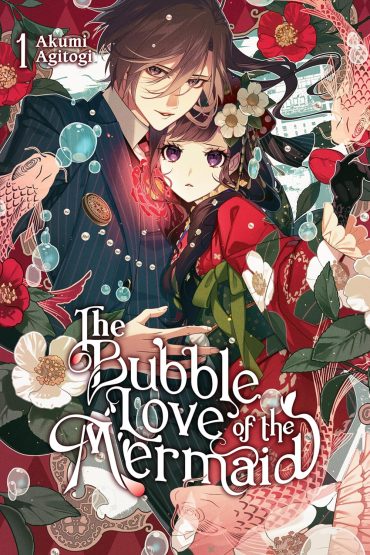
Cover art is by Mai Hanamura, and whilst it’s a lovely cover, I was very surprised to see that outside of quick character bios at the start of the novel, there’s no other art work in book. All the previous light novels I’ve read have had a couple of art spreads, so was surprised this one didn’t have any at all. It’s a shame as I think the art could have helped elevate the text a bit, like giving Asuna’s mark visual representation, or showing more of the school and its students to help it feel less flat, etc.
Translation by Nicole Wilder is good, providing an easy read.
The Bubble Love of the Mermaid failed to bubble up interest for me by the end of the first novel; the underbaked original ideas, mixed with many copy-and-paste dynamics and plot points from Akumi Agitogi’s other material, makes this light novel a disappointing series debut.
Our review copy was supplied by the publisher Yen Press.