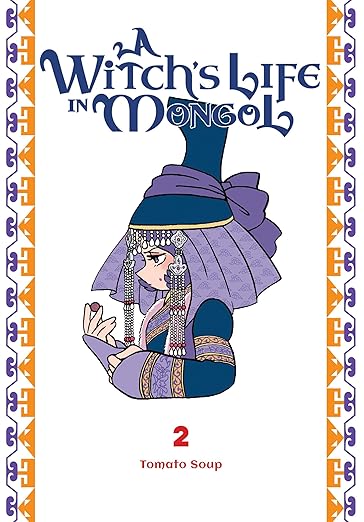
A Witch’s Life in Mongol Volume 2 Review
 Sarah •
Fatima (Sitara) has been surviving as a slave of the Mongol court in the household of Sorghaghtani Beki, first wife of Tolui (fourth son of Genghis Khan) for eight years now. She has not forgotten her life in Tus (Persia) or the kind mistress who raised her, even giving her own life to protect her when the Mongols invaded. Neither has she forgotten the rare and precious book, Elements, that Tolui stole from her mistress. Frustrated by her inability to carry out any kind of revenge, Fatima helps with everyday tasks and it’s when assisting with the butchering of a lamb that she finds a bezoar in its intestines. Knowing that the bezoar is valued for its magical properties and is called a Jada stone, she cleans it and keeps it.
But then Genghis Khan dies, and all the tribes assemble for a Grand Kurultai to choose the next emperor. When Ögedei (Genghis’s third son) is chosen, Sorghaghtani orders Fatima to infiltrate second son Chagatai’s household and tell her what’s going on there, suspecting him of plotting. However, this plan goes badly awry and Fatima finds herself in the household of Töregene, the sixth wife of new Great Khaan, Ögedei. Töregene also has a precious Jada stone but it’s gone missing and Fatima is wrongly accused of having stolen it! Is Töregene a potential ally for Fatima – or a foe?
This is a fascinating historical period of change and renewal and A Witch’s Life in Mongol gives us an unusual perspective on the everyday lives of Genghis Khan’s court through the eyes of a female Persian slave. Through Sitara/Fatima’s experiences we get to see how cheaply life is held and how many different peoples, languages and tribes are being forced to co-exist under their Mongol overlords. Mangaka Tomato Soup has done plenty of research but for the most part skilfully slips in the information we need to understand the historical background without making it indigestible (I like the helpful maps inserted at relevant moments in the text).
However, not everyone will warm to Tomato Soup’s idiosyncratic, quirky style of character design and after reading the second book, I’m beginning to fall into that camp. It’s quite hard to tell the characters apart, as they’re all, men and women, drawn with very similar faces, especially in profile. It’s also a style that almost seems better suited to a children’s book which means that when there’s some bloodthirsty or cruel action taking place, the full impact feels somewhat muted because of the smirky expressions on the faces of the perpetrators. (Of interest to Tomato Soup fans is the fact that he’s started another manga Kanshin Smbat, set in Georgia at roughly the same time as A Witch’s Life in Mongol.)
The translation for Yen Press is by Amanda Haley with lettering by Laila Nagamine and, as in Volume 1, their work makes for an effortless read, in spite of the unfamiliarity of some of the characters’ names. There’s a very useful list of characters at the front (including the Genghis Khan dynasty set out as a family tree) and at the end there’s a page explaining the Grand Kurultai (with a contemporary illustration) and a two-page preview for Volume 3.
Tomato Soup’s historical manga will soon be available as an anime (July) from Science Saru, with an impressive team working to bring this unconventional story and historical background to life (and the trailer looks very promising).
5 volumes and ongoing in Japan, however, we don’t yet have a date for Volume 3 from Yen Press! However, with Khan Ögedei planning to build a capital city while his brother Tolui is raring to go to war against the Jin (roughly northern China) the path ahead for Fatima is not going to be an easy one.
Our review copy was supplied by Yen Press.